Mechanical Design
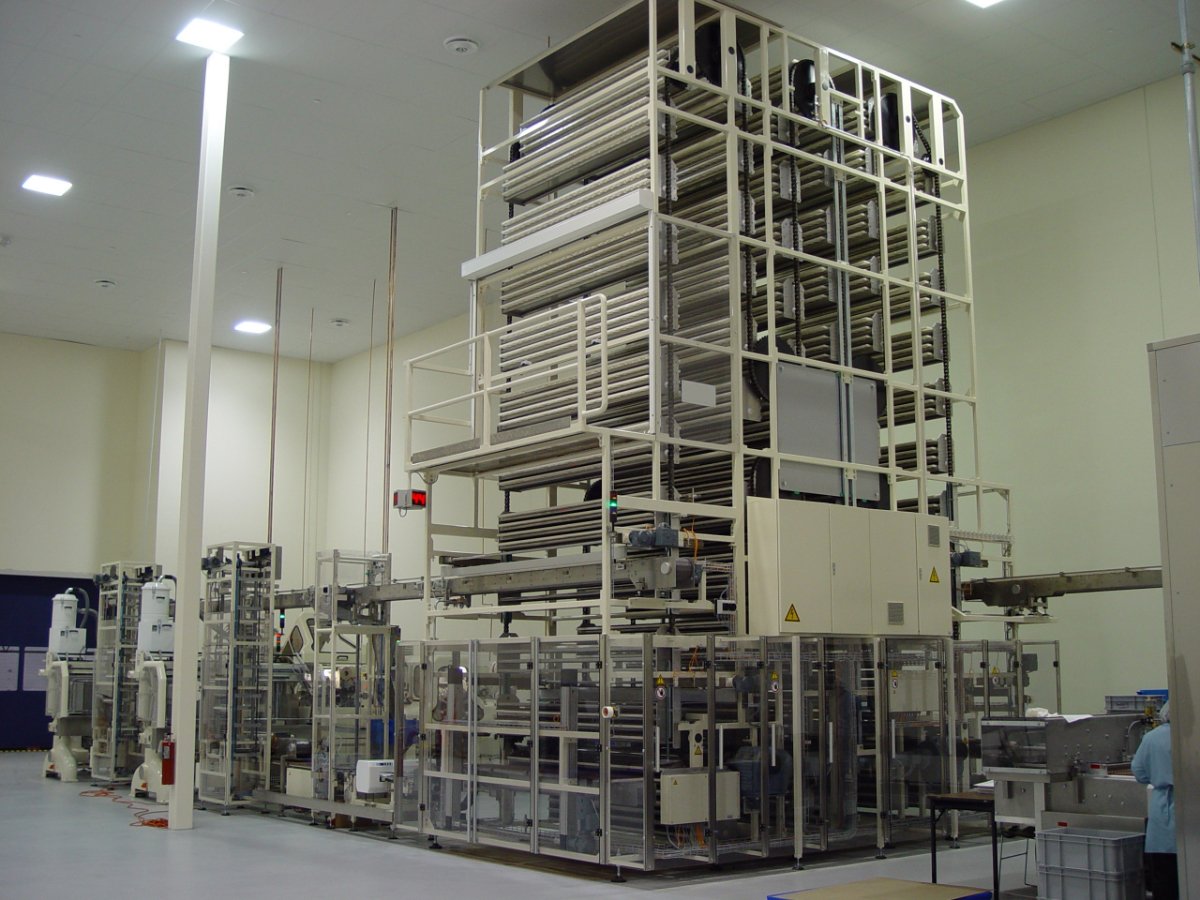
At first glance, a gondola buffer looks relatively simple: a large frame, an infeed and an outfeed side, and in the middle a large metal plate with sprocket wheels over which two chains with attached gondolas circulate to connect the two sides of the buffer.
So far, so simple. The two chains, which run along the left and right sides of the buffer and between which the gondolas are attached, move the gondolas in a continuous circuit from the infeed to the outfeed and back. And the two chains must do this absolutely synchronously and evenly to avoid undefined operating states. The chain length has a decisive influence on the achievable buffering capacity and can be way over 50 metres for each of the chains.

Systemic Decoupling
There is a large motor at the infeed and at the outfeed, which can move the chains independently of the other motor. This means that the infeed and outfeed can react independently to the operating conditions at the opposite side. In addition, one side can be stopped while the other is operating normally. Thus, a gondola buffer creates a systemic decoupling of the upstream and downstream line sections.

Build as high as possible
The metal plate with the sprocket wheels - the so-called shuttle - has a great influence on the design of a gondola buffer and its costs. Depending on the number of chain wraps, we speak of a duplex shuttle (2 sprocket wheels) or triplex shuttle (3 sprocket wheels).
For economic reasons, a gondola buffer is built as high as possible to achieve the desired storage capacity. Then a single duplex or triplex shuttle can be used. If this is not possible due to the structural conditions at site, two duplex or even two triplex shuttles must be installed in a flatter buffer in order to achieve the required chain length. More than two shuttles are technically possible and have already been realised by ICS Mechanical. However, this significantly increases the complexity within a buffer system.

Infeed and Outfeed
The products can be loaded via an infeed belt, which delivers the products almost contact-free onto the shelves, or via a feeding pusher. Each shelf holds exactly one row of products. The products are then always discharged via a discharge pusher, which gently pushes the products out of the gondola and onto a discharge conveyor.
A gondola buffer works at a First-In / First-Out principle (FIFO), which ensures that the products stored first are also unloaded first. In this way, the time of the products in the buffer is kept as short as possible and a negative influence on the quality of the products can be excluded, especially in the food industry. For particularly sensitive products, there is even the option of integrating air conditioning into the buffer.
Working Principle
The shuttle is the mechanical heart of the gondola buffer. It separates the buffer vertically into a filled part and an empty area, whereby this boundary shifts depending on the operating state of the buffer. Depending on the design and project requirements, the area filled with your products is located above or below the shuttle, between the infeed side and the outfeed.
In normal operation mode, both sides work at approximately the same speed, so that the buffer operates in pure pass-through mode without using its storage function. The shuttle moves very little and remains in a very constant vertical position.
If the operating speed now changes on one side due to newly occurring system conditions, the shuttle shifts vertically and thus changes the ratio between filled shelves on their way to the discharge and the empty shelves on their way back to the infeed side. If the proportion of filled shelves is increased compared to the empty ones, the buffer begins to fill. Conversely, the buffer is emptied if the ratio shifts in favour of the empty shelves.
Control Architecture
In addition to the high-quality mechanical design of a gondola buffer, a smart software architecture is crucial for a high-performance buffer. The control is not only the key to high feeding and distribution performance, it is also crucial for a smooth and easy chain operation. On one hand, this minimises undesired effects on the position of the products on the shelves and, on the other hand, it increases the lifetime of the installed components. Especially in this area, the quality of the various suppliers worldwide differs.